The Open Positions cards use some trading and backtesting shorthand. Here’s every term in plain English — because “show your work” only counts if you can read the work. No edge is real until it survives all of it.
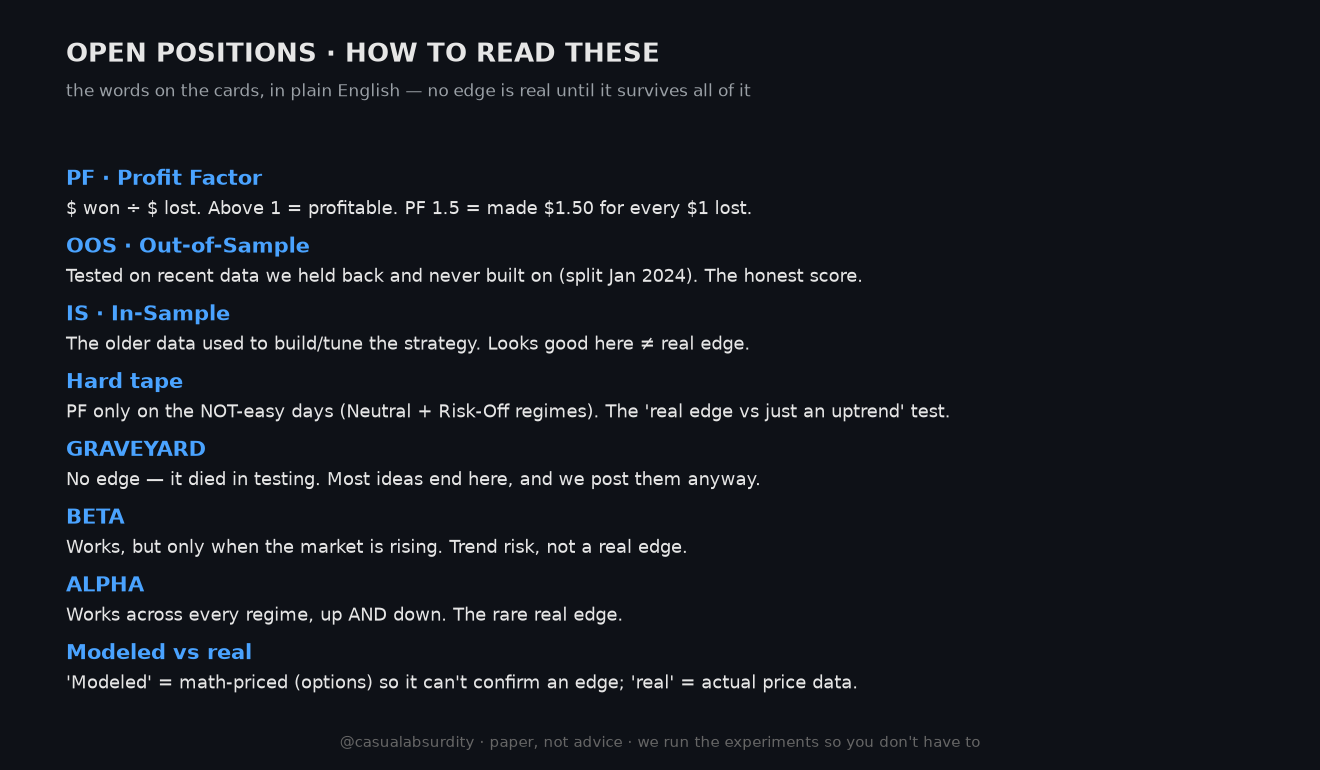
Profit Factor (PF)
Profit factor is the headline “how strong is the edge” number.
PF = (total dollars won) ÷ (total dollars lost)
A PF above 1 means the strategy made money; below 1 means it lost. A profit factor of 1.5 means it made $1.50 for every $1 it lost. It’s a cleaner read than win rate, because it weighs how much you win and lose, not just how often.
Out-of-Sample (OOS) and In-Sample (IS)
This is the honesty test, and it’s the most important idea here.
We split a strategy’s history into two parts at January 1, 2024:
- In-sample (IS) — the older data we use to build and tune the strategy. Anything can be made to look good in-sample with enough tweaking, so a great in-sample result proves almost nothing on its own.
- Out-of-sample (OOS) — recent data we hold back and never touch while building. We only test on it at the end.
The out-of-sample number is the honest one, because the strategy never “saw” that data and couldn’t have been curve-fit to it. A strategy that shines in-sample but falls apart out-of-sample is overfit — it memorized the past instead of finding a real edge.
Hard tape
Plenty of strategies make money simply because the market went up — that’s not skill, it’s a rising tide. The hard tape is the test for that.
It measures profit factor only on the days the market was not easy — our Neutral and Risk-Off regimes (a regime is our read of the market’s risk mood, built from volatility, credit spreads, and trend). If a strategy works in the hard tape, it has a real edge. If it only works when the market is calm and rising, it’s just along for the ride.
The verdicts
Every idea runs the same gauntlet and earns one verdict:
- GRAVEYARD — no edge. It died in testing. Most ideas end here, and we post them anyway.
- OVERFIT — looked great in-sample, fell apart out-of-sample. It memorized the past.
- FRAGILE — only works on one exact setting; nudge a parameter and it breaks.
- INSUFFICIENT — not enough out-of-sample trades yet to judge it fairly.
- WATCHLIST — promising but unproven. We keep tracking it.
- CANDIDATE — looks good, but it’s modeled (see below), so it can’t be confirmed without live trading.
- BETA — it works, but only when the market is rising. Trend risk, not a real edge.
- ALPHA — it works across every regime, up and down. The rare, real edge.
Modeled vs real prices
- Real prices — the test used actual historical market prices. A win here is a real result.
- Modeled — for options, we price with a math model (Black-Scholes) instead of real historical quotes. A model can flatter a strategy, so a modeled result can never confirm an edge — it can only flag something worth testing live.
Paper trading. Strategies are modeled where noted. This is education and entertainment, not financial advice.