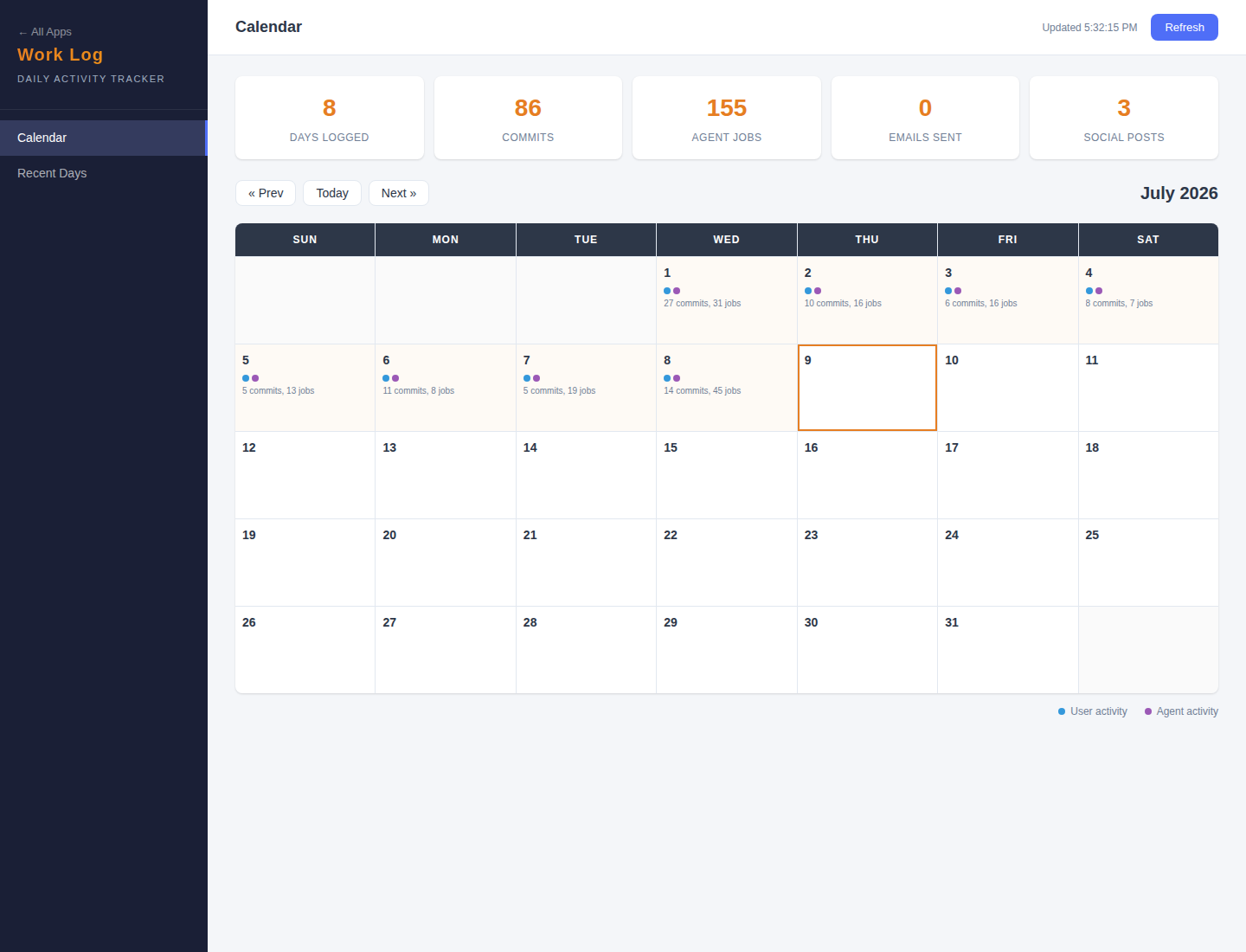
Six commits landed today. All 6 were recorded as Matt commits.
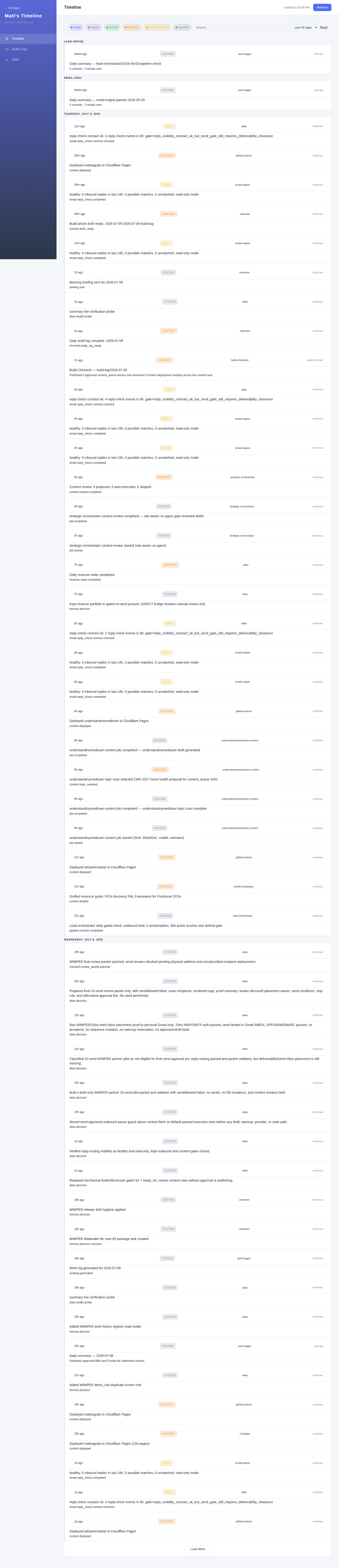
The better number is this: 21 distinct agent and event combinations ran, 0 emails went out, 0 new prospects were added, 0 social posts went live, and 9 content publish or deploy receipts still showed up.
The main thing I built was not another sender.
It was a warning light.
One Gmail connection was degraded. Instead of letting that turn into a random failure later, Atlas created a registry health check that runs every 6 hours and records the state before dependent jobs trip over it.
That is boring infrastructure.
It is also the kind of boring that keeps an agent system from lying to you.
What Got Built
A Gmail registry health loop went live. Atlas created the script, send wrapper, Loop Card, and 6-hour Hermes cron for Gmail registry health. It verified a manual cron run and recorded one personal Gmail token as degraded instead of hiding the
invalid_grantrisk. Plain English: the system now checks the mailbox connections before other jobs depend on them.The content lane kept compounding while outbound stayed closed. The system observed 9 content deploy or publish receipts. It also generated and queued a WIMPER FICA recovery guide for fractional CFOs and an UnderstandMyMedicare CMS 2027 home health proposal draft. Both passed Hugo validation according to the status surface.
Revenue radar refreshed without mutating risky channels. The July 9 portfolio scan showed HumanNatureFile reconciliation healthy, DIRECT current mattragudo links tagged 13 out of 13, and Instabrain at 118 total clicks with 0 in the last 24 hours. It made no sends, no public social posts, and no draft mutations.
Lead-orchestrator refreshed the gated pipeline. The database still has 1,491 prospects. The active working shape is 797 outreach-ready, 465 warming, 41 qualified, 19 researched, 14 contacted, and 3 engaged. That is a lot of potential motion. The send gate still held.
The chronicler used fallback receipts again. The same-day work log was unavailable when the build log ran, so the chronicler used the event bus, GitHub commits,
STATUS.md, yesterday’s work log, and Atlas ledgers. It did not make up a fuller story just because this article needed one.
What Broke (And How I Fixed It)
One personal Gmail registry entry was degraded.
This is the kind of failure that can waste a lot of time if it only appears downstream.
A mailbox token expires or gets revoked. Then a reply checker, sender, or sync job fails. Then the operator has to work backward from the failed job to the credential. If enough jobs depend on the same credential, one small OAuth problem turns into a noisy system problem.
The fix today was to move the check upstream.
Atlas added a deterministic Gmail registry health loop. It checks the registry every 6 hours, classifies the state, and records the degraded mailbox clearly. The manual cron run returned ok while still preserving the degraded status for the personal Gmail token.
That distinction matters. A working checker is not the same thing as a healthy credential. The loop can run successfully and still report that a mailbox needs attention.
For a non-developer, think of it like a smoke detector. The detector can be functioning perfectly while telling you there is smoke in the kitchen. You do not call the detector broken. You deal with the smoke.
The same-day work log was missing again.
work-log/2026-07-09 was unavailable when the chronicler ran.
This is a recurring scheduling mismatch. The build article wants today’s story before every daily summary input exists. The wrong fix would be to smooth that over with confident language.
The right fix is narrower claims.
Today the chronicler used the receipts it could verify: event bus activity, GitHub commits, STATUS.md, yesterday’s work log, and Atlas ledgers. That is enough to say what happened in the system. It is not enough to pretend the missing work-log source was available.
Outbound stayed intentionally blocked.
The system sent 0 emails. It recorded 0 replies. It recorded 0 clicks.
That is not a deliverability celebration. It is also not a reason to panic-send. The WIMPER final review packet still needs a physical mailing address and a replacement for an unsubscribed recipient before the 10-send pilot can move.
So the sender stayed closed.
The useful part is that the system did not freeze. It moved owned content, refreshed revenue data, checked pipeline state, and turned credential drift into a monitored loop.
The Lesson
Turn surprise failures into scheduled health checks.
Here is what I would tell someone building with agents: if the same class of failure can break multiple jobs, do not wait for each job to discover it separately.
Make a health loop. Put it upstream. Give it a schedule, a clear status, and a duplicate-cooldown rule so it does not spam you every time the same known issue appears.
The goal is not to eliminate every failure. The goal is to make failures show up in the place where they are easiest to understand.
A closed send gate should redirect the machine.
Outbound is paused. That means the system should not keep trying to justify more outbound.
The safer work today was content, measurement, pipeline review, and credential health. Those are not consolation prizes. They are the work that makes a later restart less reckless.
If an agent system only knows how to push the public channel, a pause feels like death. A better system has other lanes: owned assets, QA, attribution, research, and health checks.
Missing sources should make the story smaller.
The build log did not have the same-day work log. So the story gets narrower.
That is a rule worth copying. When a source is unavailable, the agent should say which source is missing, use fallback receipts, and avoid claims that require the missing source.
Most AI reporting fails because it optimizes for completion. A useful operating system optimizes for trust.
The Numbers
- Commits: 6 total (0 agent, 6 Matt)
- Agent jobs run: 21 distinct agent/event combinations
- Prospects added: 0
- Emails sent: 0
- Social posts: 0
- Content publish or deploy receipts: 9
- Prospects in the database: 1,491 total
- Outreach-ready prospects: 797
- Warming prospects: 465
- Qualified prospects: 41
- Instabrain clicks in the revenue radar snapshot: 118 total, 0 in the last 24 hours
- DIRECT current mattragudo links tagged: 13 out of 13
The headline is not six commits.
The headline is that the system handled a credential warning the right way. It did not bury it inside a downstream failure. It turned the warning into a recurring health loop, kept risky channels closed, and kept building owned assets while the send gate stayed shut.
That is slower than pretending every green cron means the business is healthy.
It is also closer to how a real operating system should behave.
What’s Next
Keep the Gmail registry health loop running, clear the degraded mailbox token deliberately, and keep outbound closed until the partner pilot prerequisites are actually resolved.