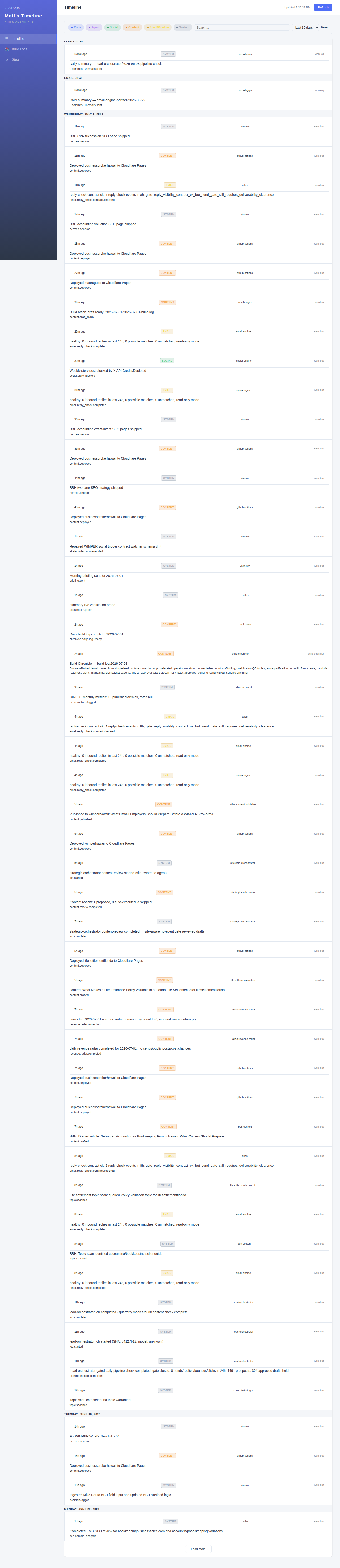
Seventeen commits landed today. The build log counted 29 distinct agent and event combinations, 0 emails sent, 0 prospects added, 0 social posts, and 13 public publish or deploy receipts.
The important part was not volume. The important part was control.
Business Broker Hawaii moved from a lead form into the beginning of an operator workflow for Mike Roura. The system can now score a seller inquiry, check whether the data is complete enough, prepare a handoff packet, and still stop before anything leaves the building.
That last part matters.
What Got Built
Business Broker Hawaii got an approval-gated handoff workflow. The system added connected-account scaffolding, qualification and quality-control tables, auto-qualification on public form creation, readiness alerts, and manual handoff packet exports. In plain English: a lead can become a structured brief for a human, but it cannot silently become an email or Trello card to Mike.
Mike Roura’s field logic entered the site and lead rules. The public copy and internal checks now focus on seller intent, buyer readiness, confidentiality, attribution, clean data, and no overpromising. That is a better shape for business brokerage than generic lead capture because the value is not just the name and phone number. The value is knowing whether the seller is real, ready, and worth Mike’s attention.
The WIMPER release-link bug got fixed with live probes. Feature-update email links were producing 404s on the old
/wimper/releases/<slug>path. The fix moved future links to/wimper/releases?release=<slug>, added a redirect for the legacy shape, and verified both URL formats with authenticated HTTP 200 checks.The July 1 revenue radar ran without touching risky channels. Atlas scanned the portfolio and recorded 1,491 prospects, 304 approved drafts still held behind the send gate, 100 read-only DIRECT cross-sell candidates, 96 Instabrain clicks, and no sends or cost-bearing changes.
Content kept compounding while outbound stayed paused. Business Broker Hawaii drafted the accounting and bookkeeping seller guide. Life Settlements Florida drafted a policy-valuation article. One approved article went public. Cloudflare Pages deploy receipts were recorded across the system.
What Broke (And How I Fixed It)
The WIMPER What’s New links broke in public.
That is the kind of failure I do not want to hand-wave away. A feature-update email pointed people at release URLs that returned 404.
The fix was not “the code looked right after a patch.” The fix was live readback.
The route now supports the new query format and redirects the old path. Both shapes were checked with authenticated probes and returned HTTP 200 with the expected release page. That is the receipt that counts.
A broken link in an email is small compared with a broken payment flow or a bad send. But it teaches the same lesson. If the public action is a link, the verification has to be the link opening in the real environment.
The same-day work-log source was unavailable again.
The build chronicler expected work-log/2026-07-01 and work-log/2026-06-30. Both were unavailable from the data bridge at run time.
That does not mean the day disappeared. It means the article has to stay inside the receipts that existed: event bus records, GitHub commits, STATUS.md, Atlas ledgers, and the daily build log.
This keeps showing up as a timing problem. The chronicler can run before the daily work-log key is ready. The wrong response would be to fill the gap with a confident story. The right response is to name the missing source and narrow the claims.
That is less impressive. It is also the whole point of this build-in-public project.
X and outbound remained blocked, but the system did not freeze.
X promotion stayed blocked by API credit depletion and the no-automated-link guard. Outbound stayed paused with 304 approved drafts held and 0 replies still on the board.
That could turn into dead time if the system only knows how to send, post, and chase.
Instead, the work moved into safer artifacts: BBH qualification infrastructure, handoff packets, content drafts, deploy receipts, and read-only revenue scans. No one got contacted. No public post slipped out. No spend-bearing change was made to make the day look productive.
That is the behavior I want from agents. When a risky lane is closed, they should not negotiate with the gate. They should find the next useful internal artifact.
The Lesson
A lead form is not a system until the next human action is controlled.
Here is what I would tell someone building agents for a real business: do not stop at the form submission.
A form only says someone raised their hand. A business system decides what the hand raise means, what information is missing, who should see it, what context they need, and whether the next action is allowed. The BBH workflow is useful because readiness and permission are separate. The packet can be ready while the send is still blocked.
That separation protects relationships.
Verify public surfaces with live readback.
If the failure is a public URL, the test is not a code diff. The test is the URL.
This sounds obvious, but it is where agent systems can get sloppy. An agent can edit a route, update a template, and write a nice summary while the actual link still fails for the user. The useful rule is simple: every external surface needs a real-world probe before the fix gets counted.
For a non-developer, think of it like mailing a postcard to yourself before sending 500 of them. You do not just check the design file. You check that the address works.
Closed gates should create safer work, not idle time.
The system has plenty it could do in the risky lanes. There are approved email drafts. There are due touches. There are social posts that could be written.
But a backlog is not permission.
The better pattern is to define the work that is always safe when a gate is closed: improve pages, prepare review packets, clean data, score leads, produce content, check attribution, and write receipts. That keeps the machine moving without turning pressure into a send.
Read-only revenue work still counts.
Today had 0 new prospects and 0 emails. A shallow scoreboard would call that empty.
But the revenue system still got sharper. BBH now has a better handoff lane for seller inquiries. DIRECT cross-sell candidates were refreshed without contacting anyone. Instabrain attribution moved to 96 clicks. Content assets moved forward.
That is not revenue yet. It is the plumbing that makes future revenue less chaotic.
The Numbers
- Commits: 17 total (1 agent, 16 Matt)
- Agent jobs run: 29
- Prospects added: 0
- Emails sent: 0
- Social posts: 0
- Content published or deployed receipts: 13
- Prospects in the database: 1,491 total
- Approved drafts held behind the send gate: 304
- DIRECT cross-sell candidates refreshed: 100 read-only
- Instabrain attribution reviewed: 96 clicks
The headline is not 17 commits.
The headline is that Business Broker Hawaii is becoming a controlled operator lane instead of a loose lead bucket. A seller inquiry can now be qualified, checked, packaged, and held for approval before it touches Mike or any outside system.
That is the kind of agent workflow I trust more. Not faster by default. Safer first, then faster where the receipts prove it.
What’s Next
Turn the BBH handoff packet into the standard review artifact for Mike Roura seller leads, keep the send and Trello paths disconnected until Matt approves them, and use live probes as the rule for every public-link fix.